Moving to Massachusetts: When to Transfer Your License
Moving can leave you unsure when your old driver’s license stops being the right one to use and when Massachusetts expects you to make a change. The key is residency: the transfer is tied to when you establish it, not simply to the day you arrive. Here’s how to think through that trigger, prepare for the process, and avoid common planning mistakes.
The Massachusetts license-transfer rule
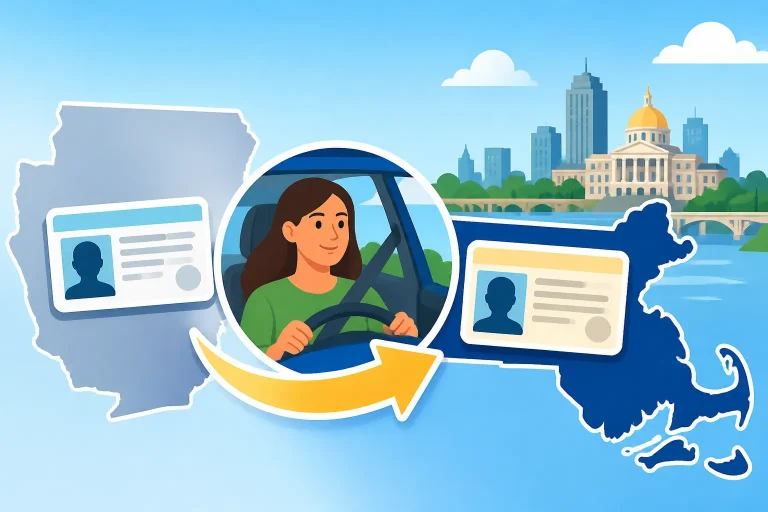
According to the Massachusetts Registry of Motor Vehicles, a driver must convert their out-of-state driver’s license to a Massachusetts driver’s license upon establishing residency.
That wording makes residency the central timing issue. It does not tell you to wait for a particular milestone such as receiving a Massachusetts ID card, signing a lease, starting a job, or registering a vehicle. Nor does it describe a general grace period. Avoid treating any one moving task—or an assumed number of days—as permission to delay the license conversion. If your circumstances make it unclear when you have established residency, ask the Massachusetts Registry of Motor Vehicles how the rule applies to you.
A move can happen in stages. You might arrive before your permanent housing is ready, split time between Massachusetts and another state, or relocate for a temporary assignment that later becomes a longer-term move. Those situations can make the residency question less straightforward than “What day did I cross the state line?” The practical step is to identify when your situation has changed from visiting or temporarily staying to establishing Massachusetts as your residence, then confirm any uncertainty with the official agency.
For planning purposes, separate two questions:
- When does the requirement apply? The stated trigger is establishing residency.
- What steps will the conversion involve for you? Confirm the current process and any applicable documents or testing requirements with the Massachusetts Registry of Motor Vehicles.
Those questions are related, but they are not interchangeable. Knowing the timing trigger does not tell you which documents to bring or whether your driving history affects the transaction. Similarly, collecting paperwork does not change when the residency rule applies.
If you are moving from another state, use How to Transfer Your Out-of-State Driver’s License to Mass as a companion resource for thinking through the conversion process. For a broader move-planning view, New Resident Timeline to Convert an Out-of-State License may also help you organize the work around your arrival. Treat those planning tools as preparation, not as a substitute for confirming current requirements with the Massachusetts Registry of Motor Vehicles.
How to think about “establishing residency”
The phrase “upon establishing residency” can feel clear in theory and uncertain in real life. People often have several possible dates in mind: the day they arrive, the day they move into a home, the day they begin working, or the day they update other records. The rule itself identifies residency as the trigger; it does not, by itself, define which event controls in every individual situation.
Avoid choosing a date simply because it is convenient or because it matches another administrative deadline. A move is a change in where you live, not just a collection of paperwork tasks. If your housing, work, family, or travel arrangements make it difficult to tell whether you have established Massachusetts residency, describe your circumstances to the Massachusetts Registry of Motor Vehicles and ask for guidance.
Situations that may need clarification
Some moves have a clean transition: a person leaves one home and settles in Massachusetts. Others are less definite. You may be keeping a home elsewhere, staying with relatives while looking for housing, commuting across a state line, or moving for a temporary purpose. Rather than applying a rule of thumb from someone else’s situation, ask the agency how it views your particular circumstances.
It can help to write down the facts before you contact the agency. Note where you are living, whether the move is intended to be temporary or ongoing, and what has changed since you arrived. You do not need to make those facts fit a predetermined answer. The purpose is to give the agency a clear picture so it can explain how the residency rule applies.
Do not confuse arrival with residency
Crossing into Massachusetts does not necessarily answer the residency question, just as completing a particular moving task may not answer it automatically. The wording “upon establishing residency” is the point to keep in view. If you are only visiting or your move is still uncertain, do not assume that the answer is obvious. If you have settled in Massachusetts, do not assume you can wait until every other move-related task is finished before addressing your license.
When the facts are ambiguous, make the RMV question part of your move checklist rather than leaving it until a later transaction. That gives you a chance to confirm the correct timing before relying on assumptions about your status or the documents you need.
Plan the conversion as a separate moving task
A driver’s license transfer is easy to overlook among housing, work, school, banking, and vehicle tasks. It helps to give it its own place in your move plan. The residency trigger determines when the requirement applies, but you can prepare in advance by checking the current official instructions, gathering relevant records, and identifying questions that need an answer.
Start with the official Massachusetts Registry of Motor Vehicles information for out-of-state license conversion. Requirements and procedures can change, so use the agency’s current guidance rather than an old checklist, a discussion forum, or a friend’s memory of a past transaction. If the instructions leave out a detail that matters to you, contact the agency before making plans based on a guess.
A practical preparation sequence
- Write down your residency question. If you are unsure whether you have established residency, describe your move and ask the Massachusetts Registry of Motor Vehicles how to interpret the trigger.
- Check the current conversion instructions. Confirm which transaction applies to your license and what the agency currently asks applicants to provide.
- Review your existing license. Note whether you have the physical card and whether your name, address, or other details create a question you should resolve before applying.
- Gather possible supporting records. Use the official checklist to determine which records are accepted. Do not assume that a document accepted for one credential or transaction will also work for another.
- Confirm how to complete the transaction. Follow the agency’s current instructions for any application, visit, booking, payment, test, or other required step. Complete those actions with the official agency.
- Keep a record of what you confirm. Save the agency’s instructions and make notes about any advice you receive, especially if your situation is unusual.
- Make a follow-up plan. If you are waiting for a document or an answer about residency, decide when and how you will check the next step rather than allowing the issue to drift.
This sequence is a planning aid, not a statement that every applicant must complete each item in exactly this way. The official agency’s current instructions determine what applies to your case.
Check documents before you make an appointment or visit
Document problems can turn a straightforward plan into a second trip or a delayed transaction. Before you travel to an RMV service center or schedule any required service, compare each item you plan to bring against the agency’s current requirements. Check the document type, whether an original or another form is required, and whether the information matches across your records.
For a structured starting point, see Checklist of Required Documents for a Massachusetts Driver’s License. If your main question is whether to request a REAL ID or a standard credential, Massachusetts REAL ID vs Standard Driver’s License: What Differs can help you identify the distinction to research. Do not assume that choosing one type changes the residency trigger; confirm the specific document rules for the credential you want with the Massachusetts Registry of Motor Vehicles.
What to verify before you start
The timing rule is only one part of the decision. Before beginning, identify what is known about your license and what still needs confirmation. A clean, current license and a complicated driving history may not lead to the same questions. Likewise, a driver with the physical card has a different practical problem from someone whose card was lost during the move.
The safest approach is to treat the conversion as an individual transaction. Check the current instructions for your license type and history instead of assuming that every out-of-state driver follows an identical route. Ask the Massachusetts Registry of Motor Vehicles when the official information does not resolve an important detail.
| Your situation | What to verify before proceeding |
|---|---|
| You have a current out-of-state license | Confirm the current conversion steps and the documents the agency asks you to provide. |
| Your license is expired | Ask whether your license’s status changes the conversion process or testing requirements. |
| Your license is lost or unavailable | Confirm what proof of driving history or identity the agency will accept. |
| Your name differs across records | Check how the agency handles the discrepancy and which supporting records it requires. |
| You have a suspension, OUI, or unresolved case | Ask how the issue affects eligibility or the steps you must complete before conversion. |
| You are unsure whether you have established residency | Explain your circumstances to the Massachusetts Registry of Motor Vehicles and ask how the timing rule applies. |
| You want a REAL ID credential | Confirm the additional documentation, if any, for that credential with the agency. |
The table points to questions, not guaranteed outcomes. For example, an expired license should not be treated as automatically acceptable or automatically disqualifying without checking the official rules that apply to your situation. A record problem may require attention before the transfer can be completed, but the details depend on the circumstances and current agency requirements.
If you have a prior out-of-state suspension or OUI-related matter, review Out-of-State OUI or Suspension: Does It Block Your Mass License? and confirm your case directly with the Massachusetts Registry of Motor Vehicles. If you no longer have the physical card, How to Transfer a Lost Out-of-State License to Massachusetts may help you organize the questions to ask. The agency, not a general guide, determines what evidence and steps are acceptable.
Avoid common timing and paperwork mistakes
Many transfer problems start with a reasonable-sounding assumption. A driver may expect a grace period, believe a vehicle registration task controls the license deadline, or think that one document will satisfy every requirement. Because the residency rule is the key timing point, it is better to check than to rely on a shortcut.
Waiting for another task to define the date
A move often involves several changes at once. You might be arranging housing, changing an address, handling vehicle paperwork, or updating work and school records. Those tasks can help you organize a move, but do not assume that one of them determines when you established residency. Ask the Massachusetts Registry of Motor Vehicles if the date is uncertain.
Do not let a pending task become an informal reason to postpone checking the license rule. If you are waiting for a lease, utility record, or another document, ask the agency what you should do in the meantime and whether that document is required for your particular transaction. Avoid deciding for yourself that the residency trigger starts only after all records have been updated.
Assuming there is a grace period
The stated rule uses “upon establishing residency.” It does not provide a specific number of days in the fact available here. That is not a reason to invent a deadline or to assume you have extra time. If you need to know how the agency applies the rule to your move, ask it directly rather than relying on an online estimate or informal advice.
Relying on an old checklist
Document rules and transaction procedures can change. A checklist saved from a prior move, an older social media post, or another person’s experience may not match the instructions that apply to you now. Review the current official requirements shortly before you complete the transaction, even if you began planning earlier.
Assuming every license history is treated alike
Your license status and driving record may affect what you need to do. Do not assume that a clean record, expired card, missing card, suspension, or prior OUI matter has no bearing on the process. Ask the Massachusetts Registry of Motor Vehicles how your specific history affects the conversion before you commit to a plan.
Bringing documents without checking the details
A record that seems relevant is not necessarily an accepted document for a particular purpose. Names may differ, records may be incomplete, or a document may not meet the agency’s current standards. Use the official checklist and contact the agency about anything that does not match cleanly. This is especially useful when you have recently changed your name or do not have the original card.
Treating a booking as approval
If the process involves a scheduled visit or other step, completing that step does not necessarily mean every eligibility or document question is resolved. Follow the agency’s instructions, bring what it requires, and be ready to address questions about your individual record. For visit-planning help, Massachusetts RMV Service Centers: Locations and Booking Rules is a useful related resource.
How the transfer fits with other move-related records
A license is one part of establishing your life in Massachusetts, but it is not a substitute for every other record you may need to update. Vehicle registration, insurance, address records, and identification documents each have their own rules and procedures. Keeping those tasks separate helps prevent a common mistake: assuming that completing one automatically satisfies another.
If you also own a vehicle, research its registration and title requirements separately. The rules for a driver’s license conversion do not, by themselves, answer what you must do with an out-of-state vehicle. Use How to Transfer Out-of-State Registration and Title to Massachusetts for that separate topic, and confirm the current requirements with the relevant official agency.
Address changes deserve similar care. A person may need to update more than one record, and the sequence can depend on the transaction. Do not assume that changing an address on one account updates it everywhere. For license-record questions, Changing Your Address With the Massachusetts RMV After Moving covers the related issue of address updates.
Keep your decisions and documents organized
A simple move folder can reduce confusion. Keep your current license information, any agency instructions you have checked, and notes about unresolved questions together. If your name or other details differ across records, note what needs explanation and ask what evidence the RMV accepts before submitting an application.
You can also keep a short list of outstanding tasks, such as confirming residency timing, checking which documents apply, or resolving a record question. This does not create a legal deadline or replace official instructions; it simply helps you avoid losing track of the issue while managing other parts of your move.
Make a clear distinction between questions and requirements
When reading information about a transfer, mark which points are confirmed requirements and which are questions to verify. For example, “the conversion is required upon establishing residency” is the timing rule stated by the Massachusetts Registry of Motor Vehicles. “I may need a particular proof of address” is a question to answer from the current official checklist. Keeping that distinction clear prevents a planning suggestion from turning into an unsupported rule.
When to ask the RMV for help
Contact the Massachusetts Registry of Motor Vehicles when you cannot confidently identify the residency trigger, your license status is unusual, or your records do not fit the standard instructions. It is better to ask a focused question early than to make a decision based on a guess and discover later that the agency expects a different step.
Before contacting the agency, gather the facts that explain your situation. You might note when you arrived, where you are currently living, whether you intend to stay, whether you still maintain a home elsewhere, and whether your license is current and available. Share only what is relevant to the question and ask what additional information the agency needs.
Good questions are specific and neutral:
- “Based on these living arrangements, how should I determine when I established Massachusetts residency?”
- “What current process applies to my out-of-state license status?”
- “What documents does the agency currently accept for this transaction?”
- “Does my license history require an additional step before I can convert it?”
- “If I do not have my physical out-of-state card, what proof should I provide?”
- “Should I make an appointment or complete another step before visiting?”
The agency’s answer should guide your next move. If you are told to complete an application, schedule a visit, take a test, pay a fee, or submit records, complete that action through the official Massachusetts Registry of Motor Vehicles. Check current transaction instructions before paying or traveling, since procedures can change.
For office visits, use the official agency’s office locator to find a nearby location and its current hours. Do not rely on an old listing or assume that every location offers the same services. If the agency directs you to an online process, follow its official instructions rather than submitting personal information through an unrelated service.
A practical decision path for new residents
If you are unsure what to do next, use this decision path to separate the timing question from the paperwork question:
- You have established Massachusetts residency. The Massachusetts Registry of Motor Vehicles says a driver must convert an out-of-state license upon establishing residency. Check the current conversion process and proceed according to the agency’s instructions.
- You are still unsure whether you have established residency. Describe your living arrangements and intentions to the agency. Do not choose a date based only on a convenient paperwork milestone.
- You know residency is established but have not checked the requirements. Review the current official checklist and confirm the exact transaction and documents that apply to your license.
- Your license is missing, expired, or affected by a record issue. Tell the agency about the issue and ask what proof or additional steps apply before proceeding.
- You want to choose a credential type. Compare the current standard and REAL ID instructions, then confirm the requirements for the option you select.
- You are managing vehicle paperwork too. Track that as a separate task and verify its rules independently.
- You have completed the agency’s steps. Keep any confirmation or temporary documentation the agency provides and follow its directions about what to do next.
This approach does not assign a deadline beyond the residency trigger stated by the Massachusetts Registry of Motor Vehicles. It helps you act on the rule without making unsupported assumptions about exactly how your documents, license history, or living arrangements will be treated.
The most useful takeaway is straightforward: do not wait for an assumed grace period or let another moving task decide the timing for you. Identify when you establish residency, confirm any ambiguity with the Massachusetts Registry of Motor Vehicles, and use its current instructions to complete the conversion.
Frequently Asked Questions
Do I have to transfer my out-of-state license when I move to Massachusetts?
According to the Massachusetts Registry of Motor Vehicles, a driver must convert their out-of-state driver’s license to a Massachusetts driver’s license upon establishing residency.
Is there a set number of days to transfer my license?
The stated rule uses “upon establishing residency” and does not give a specific number of days. Ask the Massachusetts Registry of Motor Vehicles if you are unsure how the trigger applies to your circumstances.
Does arriving in Massachusetts automatically mean I have established residency?
Arrival alone may not resolve your individual situation. If your move is temporary, staged, or otherwise unclear, explain your circumstances to the Massachusetts Registry of Motor Vehicles and ask how it applies the residency rule.
What if my out-of-state license is lost or expired?
Do not assume the same process applies to every license status. Check the current instructions and ask the Massachusetts Registry of Motor Vehicles what proof or additional steps apply to your situation.
Can I wait until I finish my other moving tasks?
Do not assume that another task creates a grace period or controls the license timing. The stated trigger is establishing residency, so confirm your timing and complete the conversion according to the agency’s current instructions.
Sources
- Massachusetts Registry of Motor Vehicles — Transfer Your Real Or Standard Out Of State Drivers Or Motorcycle License To Massachusetts (checked November 11, 2026)
Disclaimer
This article is for general informational purposes only and does not constitute professional advice. Laws, prices and regulations vary by location and change over time. Consult a qualified professional for guidance on your specific situation. Massachusetts Driver Guide is not a government agency and is not affiliated with any state motor vehicle department.